One Hundred Pages
on punishment, preparation, and finding the work waiting for me

“I smiled thinking that this was what freedom looks like. A kid who has the luxury of being difficult.” — Chapter 1: Homecoming
In the seventh grade, I got in a fight on the bus ride home from school. The boy I hit was mocking me and I had a short temper and socked him straight across the jaw. The fight ended as soon as it started. The bus driver, who had barely even left the campus, parked and pulled us apart. We were both crying, me in anger, the boy in shock.
Somehow, the school didn’t punish me. I cried in front of the principal, which he took as remorse, but in all honesty, my tears were more in fear of any disciplinary actions that might come my way. Still, he let me off with a warning after I apologized to the other boy and I felt somewhat relieved to have avoided any serious punishment.
At home, however, my parents were less than thrilled. It didn’t matter to them that the school saw no reason to punish me. They had long felt my temper was too short and I needed to learn better to control my emotions. I was prepared to be grounded, to lose TV or video game privileges, but instead my father decided that I should write 100 pages worth of compositions.
English was a learned language for my parents; they knew their ability to help me with writing was limited. It showed in my academics as well, where I often aced the math tests, I was merely average in anything that had to do with writing. So while this was an atypical punishment, to my father, it made perfect sense as a way to force me to confront and work on my shortcomings directly. When he laid down this punishment, I was at first appalled. One hundred pages was so much! Then I had questions, does it have to be one big long composition, can I break it up? Yes, I could write as many compositions as I needed to, about anything really, I just had to write.
So I wrote whatever came to mind. It took me months to finish. I wrote about a goldfish that disappeared. I wrote about my life. I made up poorly fleshed out stories just to get my page count up. As I slogged through, I started to play with the spacing and margins to fill the pages faster. Toward the end, my stories got shorter and shorter as I used half pages to my credit. Finally when I finished, I had 100 pages of poorly written compositions, but my father didn’t care so much about the quality versus the practice of just writing.
To build on these efforts, my mother had me apply to summer camp at the Center for Talented Youth (CTY), a 3 week sleepaway academic camp that required a passing SAT score to get in. Mine showed exactly who I was: 700 in math, 480 in verbal. But for a seventh grader, this score was good enough to qualify for the language arts classes where my parents enrolled me in the first writing class, centering around non-fiction.
I wasn’t enthralled with the idea of going to academic camp. But the site, Dickinson College in Carlisle, Pennsylvania, happily coincided with where the Washington Redskins held training camp. My cousins who had been the year prior told me stories of how they got to meet and obtain autographs from the players. Heath Shuler had just been drafted with the fifth pick and I was 100% certain he would be the next great quarterback leading us to Super Bowl glory. My fandom won out over my disdain for writing.
Yet something shifted that summer. Between autograph sessions, I found myself enjoying the class. Enjoying the writing. For the first time, I saw myself as someone who could tell stories. Writing was no longer a tedious assignment, but a way to make sense of things; a way to channel my emotions.
We had a live-in nanny who lived with us during the week since I was three. She retired right before summer camp and drove with my mother to drop me off for the final time. I cried that first night, the first night I spent away from home, the first night I would be fully without her. At the end of the three weeks, I wrote about her. I called it “Second Mother.” It won accolades from my classmates and teachers. I don’t remember exactly what they said, but I remember the feeling: I wrote something that moved other people.
The next summer, the Redskins moved their training camp to a different location. I went back to CTY anyway for the next two years.
In my third year, I signed up for Crafting of Fiction. We’d write several short stories, then revise one throughout the three weeks. I knew what I wanted to write before I even arrived. I wanted to write the story I grew up with. The story of my parents.
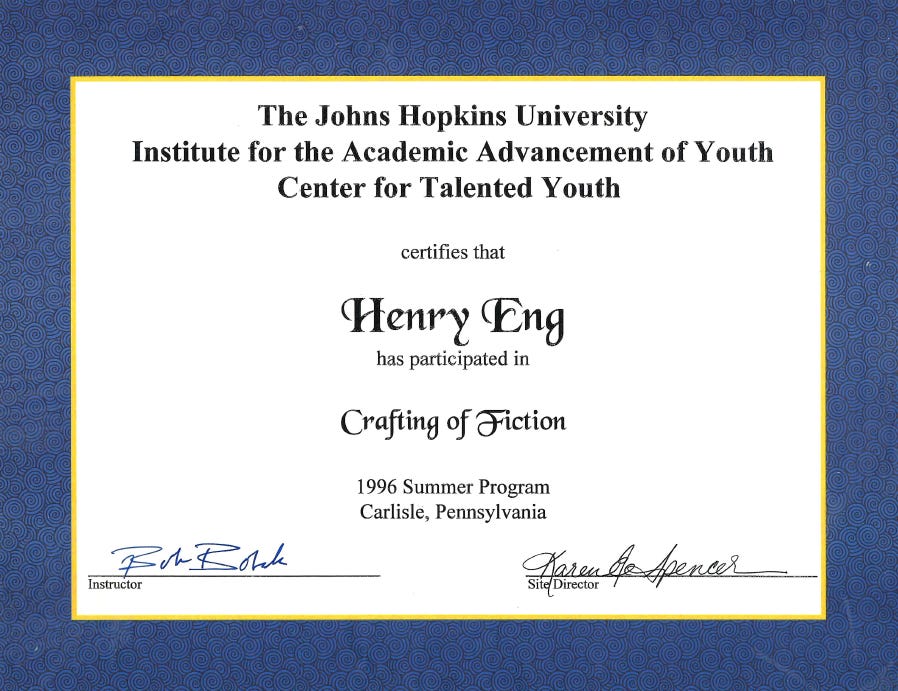
I titled it “Need for a Breath,” a nine page short story based off my parents’ journey from China to Hong Kong. I made up new character names and the dialogue. I imagined the Red Guards and the rooftop escape and the paranoid nights. It began: “I have been planning this for two years.” I had no idea how true that would become.
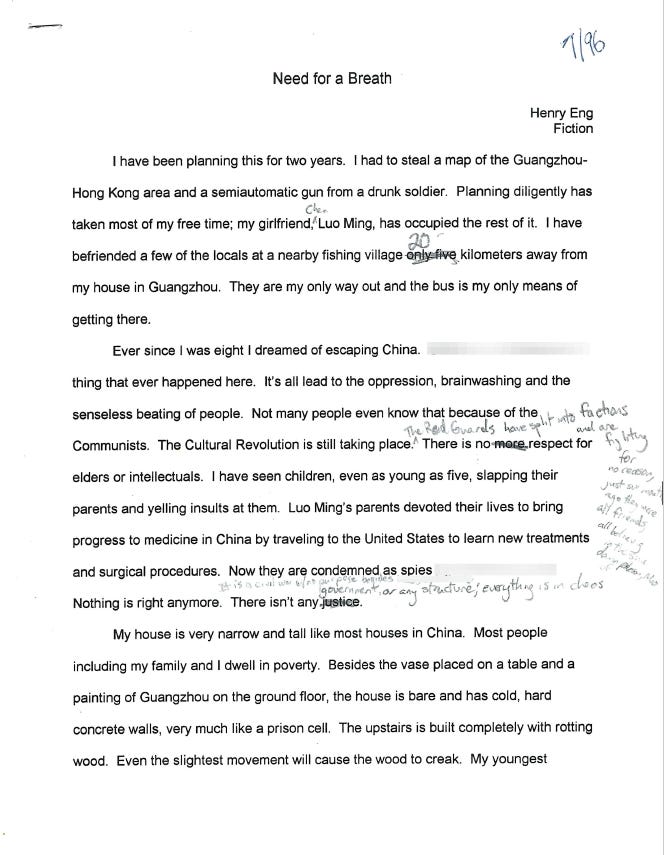
Reading it now, I cringe at some of the choices from my burgeoning teenage years. The dialogue is clunky and the pacing uneven. But the bones are all there: the planning, the escape with my mother and his youngest brother, the sparrows killed during the Great Leap Forward, the struggle sessions, the help from a local fisherman, the anxiety.
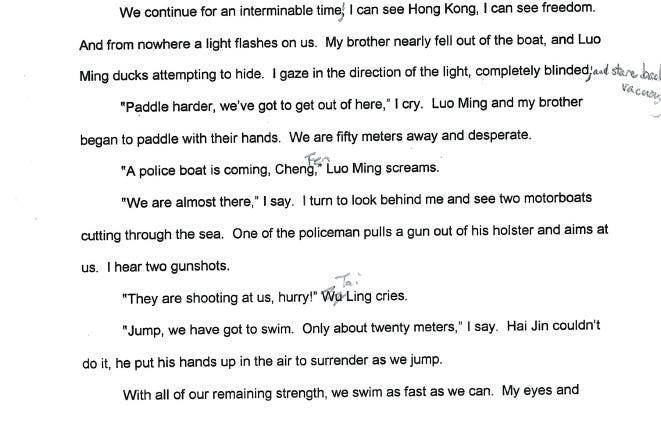
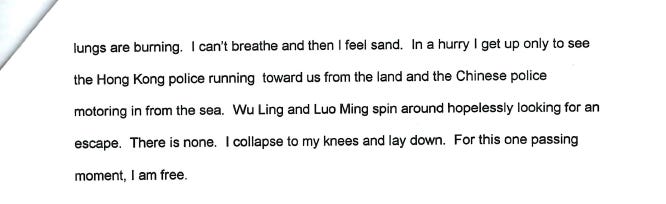
The only difference is that in my version, they get caught. Right when they reach Hong Kong shores, the police close in. All the struggle proves hopeless except for one fleeting moment of freedom.
I didn’t know what I know now. I didn’t know how my father chose to take his youngest brother over his sisters. I didn’t know then about the brillo pads or the seven years his father would spend in a labor camp. I didn’t know he almost left my mother behind. But somehow I knew the boat. I knew the water. I knew the fear. I must have absorbed more at the dinner table than I realized.
Almost thirty years later, my father handed me his memoir in Chinese and asked me to help him put his life on paper. I remembered how he and my mother had carefully infused the identity of a writer into me. But I had completely forgotten about this short story.
When I found it, snooping through old boxes for artifacts for this Substack, I discovered that I’d been preparing my whole life. We’ve gotten to this point now because decades ago, my father punished me with 100 pages. I’ve now given him 365 pages back. But I started with these nine.
If you enjoyed, you can find past posts that reveal a bit more about our journey crafting this memoir here:
The Story Behind the Story: on memory, inheritance, and becoming the keeper of a life
The Toad that Ate Swan Meat: on family artifacts, improbable inheritance, and proof
The Book I Couldn’t Read: on language, shame, and finally reading my father
Impossible Choices: on family, protection, and the cost of survival
The Island That Wasn’t There: on carry-on luggage, photobooks, and stories that outlast evidence
this is so beautiful henry. i too got into fights when i was a kid haha (probably why i do martial arts now), and writing has been a wonderful catharsis for me, too. maybe because both getting angry and writing require you to be very present.
I loved this. Thank you for sharing it. The circles from youth to middle age are real.