Blessed
on broken bones, death threats and irrational belief

“We’re really here,” Chi-Chao kept saying, walking through rooms that felt impossibly large after years of cramped quarters.
“You’re here,” I corrected. “I’m just studying for the chance to be here.”
She grabbed my face between her hands, forcing me to look at her. “We’re here.”
— Chapter 29: The Right to Try
A narrow trench of light pushed through our guest room window, half-sunk into the earth. We lay together, my mother and I, cuddled on a single bed under a ribbed orange blanket. My father was on one of his twelve-hour hospital shifts. It was just us.
She had just finished reading a Curious George book and asked if I wanted to keep going. My pride swelled knowing I had a chance to take care of her. “I’ll get a book!” I exclaimed. Before she could respond, I scrambled out of the room and up the stairs. I couldn’t wait to get back to her, to be in her arms, listening to her read to me. I didn’t have a single other want in the world.
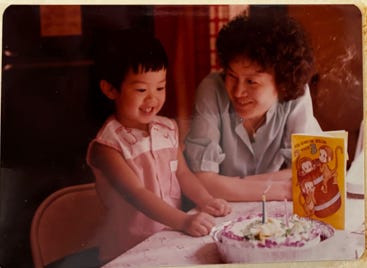
I grabbed a book and bounded down the first flight of stairs, turned the corner without losing any speed to go down the second. That’s when I slipped and tumbled, crashing into the tiled basement floor. Next thing I knew, my mother was carrying me out to our car as I wailed in pain.
This is my first real memory. I was three years old. I don’t remember the hard landing itself. I don’t remember the hospital or the broken collarbone later. All I remember is how excited I was to get back to her.
Despite my injury, this memory, and most of my early memories with my mother, radiates joy. That feeling right before my accident was as pure a happiness as I have ever felt. She always gave me the entirety of her attention. Once she falls in love with something — a person, a problem, an idea — she stays in love with it obsessively. She believes in it irrationally and without exit.
It shows up in her work. Twelve-hour days, every day, for more than thirty years. She would have worked longer days if I hadn’t called her at 8pm every night to ask her to come home for dinner. She jetsetted to conferences all over the world, bringing me to most of them. Somewhere in there, she became one of the most cited scientists in her field. Nearly 700 scientific publications to her name.
It showed up in me. When she wasn’t working, her time and attention never went anywhere else. I was the only child, spoiled with love and attention. On weekends she took me everywhere — museums, parks, road trips — even with a fever, even with all her work looming on the other side of Sunday.
It is the only reason her relationship with my father survived. After their escape from China, my parents got separated for three years. She trained in America. He sanded floors in Hong Kong. Most marriages don’t survive that. But over that time she never once stopped writing my father letters, often twice a week, even when he barely ever wrote back.
It can also be maddening. As I got older and sought more independence, it felt smothering. We fought all the time. Her focus comes with tunnel vision. Social nuance is not her strength. It certainly tests my father’s patience. But most of all, it drives me crazy when I fail and she tells me it’ll be okay. Because sometimes it isn’t okay. And she doesn’t know that it will be. She just believes it.
Still, despite her lack of social grace, my mother has many friends. She trusts freely, sometimes more than she should. She helps others wholeheartedly without calculation — she’s gotten internships for friends of mine she barely knew. She has no protective shield. After everything she’s lived through, she still believes the world is fundamentally good.
That’s what confused me, working through the memoir. I’ve seen the opposite in plenty of first-generation immigrants — people who fled from corruption and learned to trust no one. Who assume everything is a scam. Who wear their ability to spot a fraud like a badge of honor.
My mother had every reason to become one of those people. She watched people around her turn on her parents — doctors who’d dedicated their lives to patients, who’d founded one of China’s first eye hospitals. She watched them denounced. Put under house arrest. She watched her sister have a mental breakdown so severe she had to be committed. She watched as her close friend from middle school ransacked her house with other Red Guards looking for imperialist propaganda. She was unable to see her parents for over a decade, smuggling messages through mutual friends on the back of business cards.
And still, she trusts. Still, she believes. Her buoyancy makes no sense.
“I’m so lucky,” she says often despite all the trauma she has had to endure.
One day after I wrapped up the first draft of the book, I asked her why she says that, after all she went through. My mother smiled. “I have a good son, a wonderful daughter-in-law and the best grandchildren.”
“Yeah,” I said, “But life to get here wasn’t easy.”
She shrugged. And something in me felt frustrated. Not at her, but at the gap between what she had lived through and how lightly she carried it. I started running through her past, looking at every injustice I could remember her enduring.
”What about when you found out that the male fellows were paid more than you and all the other female directors? What about all the sexism you faced at work?”
”I had a good career at the end of it,” she replied unfazed. “That wasn’t right, but that didn’t deter me from the work.”
”What about when the FBI had to help you?!” I asked.
She paused, not quite remembering. “The FBI…the FBI contacted me several times because I came from China. I think they have a file on me.” She almost laughed.
I was taken aback. Not only was this not the example I’d been thinking of, but she was suspected by the country she’d escaped to. And somehow, she was amused.
”No not that. I remember…” I paused, racking my brain. “I remember we invited a FBI officer to our house because they helped you. I think you got blackmailed?”
She scratched her head and her eyes lit up. “Oh, yes, yes, I got a death threat. There was a Chinese postdoc who didn’t get renewed. He wasn’t even my postdoc, but I translated for him often. He got very upset and sent me death threats. The FBI came to our labs! People were very concerned, but they caught him. We invited the FBI officer to our house for dinner!”
A death threat! And still nothing in her face shifted. Still no resentment. Still no fear. I got more frustrated. But I knew there was more so I kept pushing. And that’s when I remembered my first memory.
Why I’d been so proud. Why I’d run upstairs for the book. Because moving was hard for her. That’s why we were lying on a bed in the basement guest room. She was tired and her joints hurt. She was showing. I wasn’t just taking care of her, I was taking care of my soon-to-be baby sister.
“What about Mui Mui?” I said. Little sister in Cantonese. What my mother had told me to call her before she was born.
”Yes…” She stopped.
She looked past me as her eyes welled up.
I regretted saying anything. I regretted scouring my brain for the injustices that happened to her just to bring down her positivity. I regretted bringing up my stillborn sister, lost at seven months. The sister my mother used to promise me was looking over us. We hadn’t talked about her in decades.
Almost on cue, my daughter ran into the room.
My mother turned her head to greet her. Her bright smile returned. “Emily!” She exclaimed, giving her a tight hug.
Then as Emily ran back out, my mom said it. “We’re blessed.”
Thank you, Mom. For believing in us all even when it didn’t make sense to.
Happy Mother’s Day
If you enjoyed, you can find past posts that reveal a bit more about our journey crafting this memoir here:
The Story Behind the Story: on memory, inheritance, and becoming the keeper of a life
The Toad that Ate Swan Meat: on family artifacts, improbable inheritance, and proof
The Book I Couldn’t Read: on language, shame, and finally reading my father
One Hundred Pages: on punishment, preparation, and finding the work waiting for me
Impossible Choices: on family, protection, and the cost of survival
The Art of the Cut: on West Coast Swing, learning when to break the rules and deleting my father’s ex-girlfriends
The Island That Wasn’t There: on carry-on luggage, photobooks, and stories that outlast evidence
Could You Survive on That Island: on cruises, 40 years of tragedy and the parenting paradox
Two Different Races: on reality TV, Confucianism and naming the unnamed
Dearest Henry, thank you so much for this beautiful Mother’s Day tribute. Reading your words is a gift that moves me deeply. I am incredibly proud—not just of your many accomplishments, but of the thoughtful man and father you have become. I am so lucky to be your mother and to see the wonderful life you’ve built. Sending all my love to you, your wife and my two lovely grandchildren.
Henry what a heartwarming testament to the unwavering love and resilience of your beautiful mother.
I think even we are all blessed just to read her outlook and perspective on what would usually break people. Happy Mother's Day to her. Stay blessed 💐