Don't Be Scared
On keeping secrets, basketball and the chapter that came to be

“Ban Zhao saw it all. As soon as they left, she locked herself in the bathroom…She’s losing herself,” Chi-Chao finished.
— Chapter 13 - When Storms Become Seasons
It’s never fair to judge other parents. You don’t know their situation. You don’t know if it’s the parenting or the kid. Heaven knows how often I tell my daughter to put her dirty clothes in the laundry. I tried multiple different ways to get this message through, and yet half the time, I’ll see a random sock in the stairwell or pants in the middle of the floor.
Still, my wife and I can’t always help ourselves. When certain situations present themselves, we’ll gab around the dinner table about how so and so needs more discipline and that we would never let our kids get away with that behavior. And after we get it off our chest, we’ll catch the kids listening.
“Don’t tell your friends that we said this,” we’ll direct them. And this is how our kids learn discretion. About what is appropriate to say out loud and what is not. The back-channel before the front-channel. The way grown-ups talk when they think no one’s listening.
Children, though, are always listening. I know I did as a child. Inevitably my parents would tell me not to repeat something they’d said outside the dinner table. And I would swell with pride. Let in. Trusted with a secret only adults were supposed to know.
But some secrets are heavier than others.
When I was twelve, my mother took me back to China. I had been several times before, often to visit distant relatives who would say I was hen gao or very tall for my age and ask ni hui shuo Zhongwen ma? to which I would sheepishly shake my head. Even if I could speak a little bit of Chinese, I was too embarrassed to try.
This trip, however, was different. We were going to Shantou, a city on the southeast coast to visit my mother’s oldest sister, Ban Zhao. She lived in a psychiatric institution there. I had somehow always known Ban Zhao was mentally unwell, though at that age, what that exactly meant was unclear.
My mother gave me two instructions along the way. First, I was to be especially kind to her. I wasn’t sure what to expect, but I knew how to be nice.
The second was much harder. My grandmother had passed away a few years prior and Ban Zhao had no idea. The doctors had told my mother that Ban Zhao had been making good progress. They were afraid that learning of her mother’s death could create a setback that she might never recover from. So the family decided to keep it from her. Ban Zhao believed her mother was alive, living in America, unable to visit.
I was to say nothing.
I didn’t really understand. I asked all the questions a twelve-year-old asks. How could somebody not know their own mother had passed away? Wasn’t it suspicious she never came to visit? My mother was firm. The doctors knew best. Ban Zhao’s mind wasn’t all the way there, and her hallucinations and psychosis had been dissipating.
My confusion was outweighed by the fact that my mother trusted me with this. I felt almost grown up and I would not fail her.
The institution was a cluster of cement buildings on the edge of the city. It was hot. Mosquito netting hung over the open windows. Other patients milled around the grounds — some quiet, some not, all of them in the kind of unstructured proximity that a twelve-year-old American kid had no frame for. I had not been in a place like this before. I have not been in one since.
I held my mother’s hand and tried to look like I belonged.
And then Ban Zhao saw me.
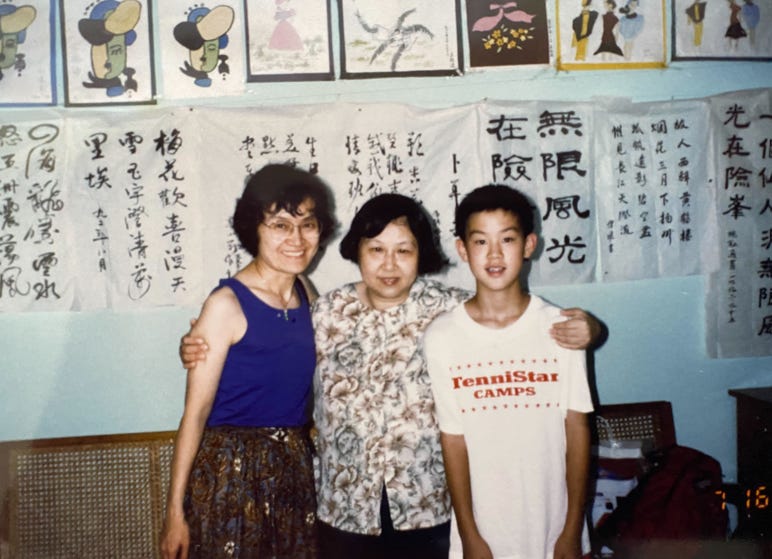
Her face opened in a way I will never forget. She came toward us with both hands out, calling my name, and for the first time since we’d walked through the gate I forgot about the cement and the netting and the other patients. She was so happy to see me that I stopped being scared.
We were given the guest suite for the next few days with its own bathroom and netting around the bed. Ban Zhao stayed in the adjoining room.
Ban Zhao tried to speak to me in the simplest Chinese she could find. And unlike other relatives, for some reason, I found myself trying to communicate back to her. She waited patiently as I struggled through my rudimentary vocabulary, lighting up when I managed even the most basic answer.
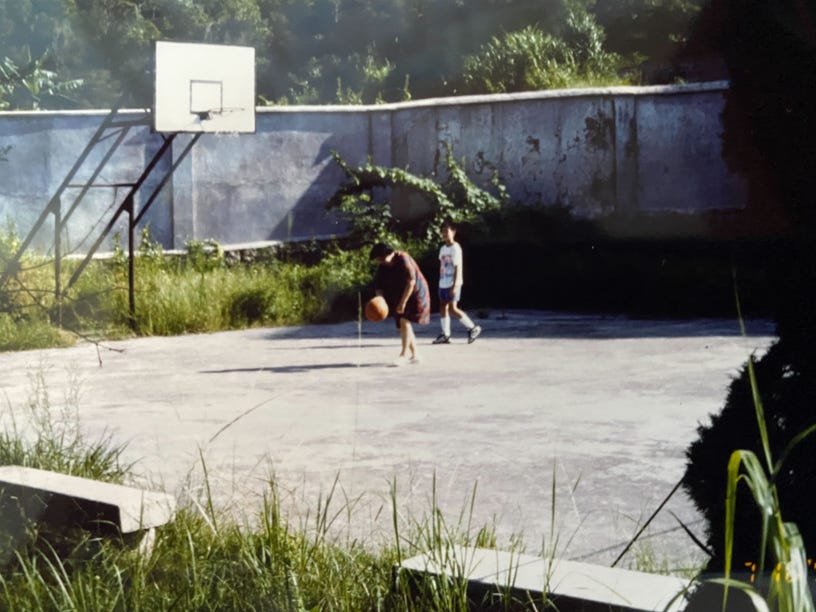
She had heard through my mother that I liked basketball and she was most excited to take me to their basketball court to play. There were no lines on the concrete and vegetation had overgrown all around. It didn’t matter. We had found an activity that didn’t require many words. Apparently basketball was her favorite hobby too, and while she wasn’t very good, she laughed with almost every shot and cheered wildly when I made one. We laughed like we were the same age. I remember thinking she didn’t seem sick at all.
That night, as I slept in a room near hers, at some point I heard her moving around, and I held still, the way kids do when they’re not sure what’s happening. She was whispering to herself, and then I realized she was whispering to me.
Bu pa. Bu pa.
Don’t be scared. Don’t be scared.
She was worried she would frighten me because she knew that I knew she was sick. And I thought to myself how silly. I already knew that my aunt, who I had just met, loved me deeply. I fell back asleep.
In the morning, we played basketball again.
We left after a few days. My mother had handled the difficult parts of the visit — the conversations with the doctors, the navigation of what could and couldn’t be said, the careful management of the lie about my grandmother. I had done what I was asked. I had said nothing.
On the way home I felt the kind of pride a twelve-year-old feels when they think they’ve passed a test. I had carried something important and I had carried it well. I had been trusted, and I had not failed.
I thought I understood what I had done.
I did not understand what I had done.
I knew Ban Zhao had gotten sick during the Cultural Revolution. My mother had told me that much. She got sick. That was the phrase. Sick the way a person gets sick, the way an illness arrives. I had no frame for what that actually meant. I thought I had carried a secret about her mother. I thought the rest of it — the years in Shantou, the doctors, the mosquito netting — was something that had happened to her because she was unwell, the way unwell people sometimes end up in places like that.
I went home to America. I grew up. But I always remembered her in the way you remember a single perfect summer day.
My mother kept visiting her, every time she went back to China alone. She would come home with reports. Ban Zhao asked about you. She asked if you are still playing basketball. For decades, my aunt and I had a relationship that lived entirely in my mother’s hands. She carried both ends of it. Ban Zhao always asked about a nephew she had seen once. I grew up into someone she would never meet again. And yet whatever we had between us did not fade.
When Ban Zhao passed away in 2020 during the pandemic, my mother told me right away when it happened. She was sad in the particular way she gets sad, which is to say she absorbed it and kept moving and did not let it linger in her face. She had a tragic life. That was what she said.
A few years ago, as I worked through the parts of my father’s memoir on the Cultural Revolution, it dawned on me that I did not actually know Ban Zhao’s story. And she wasn’t in the manuscript.
I noticed late. I had been deep in other material, other stories, other people. But at some point I realized she wasn’t there, and I asked my mother whether they had been with Ban Zhao when she had her breakdown.
My mother nodded. And then she began to tell me the story that had been encapsulated, for decades, in the phrase “she got sick.”
And as I listened to her, I realized that the twelve-year-old in the cement room with the mosquito netting thought he was protecting his aunt from one piece of news, but he did not know what he was actually protecting.
He didn’t know that the woman whispering don’t be scared in the dark had developed a paranoia that someone was always watching her and her family. That she had once been surrounded by Red Guards preparing to beat and arrest her, and that my father had intervened to pull her out. He didn’t know her breakdown was protracted and specific, and that my parents had been there for all of it.
He didn’t know that the simple Chinese she was using to ask him about school was being spoken by a woman whose mind had been broken by people in her own neighborhood and that the institution in Shantou was where what was left of her had been allowed to settle.
He thought she was sick, when in reality, she was a survivor.
Ban Zhao is the relative I remember most fondly. Not my grandfathers. Not the cousins. Not the great-aunts and great-uncles who filled the dinners on those trips. The one who stayed with me was the one I met once, for a few days, in an institution for the mentally unwell.
Part of it was that we weren’t fighting the same language barrier I’d had with the others. Her Chinese was simple. Mine was bad. We met in the middle the way two people meet in the middle when both of them are trying. Part of it was the basketball.
But mostly, I think now, was that she just wanted to show me there was nothing to be afraid of. She wanted to show me, more than anything, that she was my aunt who loved me.
I had been told to protect her and she had been trying to protect me.
And decades later, when I sat down to help my father tell our family’s story, there is a chapter in his book now because of a twelve-year-old who didn’t know what he was doing, holding a secret he didn’t really understand, in a hot room in Shantou with mosquito netting and a hoop somewhere on the grounds and a woman whispering through the wall, don’t be scared, don’t be scared.
Thank you for reading. If you enjoyed, you can find past posts that reveal a bit more about our journey crafting this memoir here:
The Story Behind the Story: on memory, inheritance, and becoming the keeper of a life
The Toad that Ate Swan Meat: on family artifacts, improbable inheritance, and proof
The Book I Couldn’t Read: on language, shame, and finally reading my father
One Hundred Pages: on punishment, preparation, and finding the work waiting for me
Impossible Choices: on family, protection, and the cost of survival
The Art of the Cut: on West Coast Swing, learning when to break the rules and deleting my father’s ex-girlfriends
The Island That Wasn’t There: on carry-on luggage, photobooks, and stories that outlast evidence
Could You Survive on That Island: on cruises, 40 years of tragedy and the parenting paradox
Two Different Races: on reality TV, Confucianism and naming the unnamed
Blessed: on broken bones, death threats and irrational belief
Hindsight is more visceral in many ways that we don't realize until so much later.
The memories you have as a child drift in like incense through a temple. At least they do for me. Whenever I smell incense, my family is what I think of the most.
I remember feeling a little scared to see my family each time as a child. We only got to see them every six or seven years, but it seems like no time at all has passed when we do. Like a ball that rolls and comes to rest, we just come together and give it another push.
Thanks for sharing this, Henry. Your aunt sounded like she was a lot tougher than she let on.
Your description of basketball almost as your own language where you and your aunt understood each other best is so beautiful. It reminds me so much of the way my great grandpa found ways to communicate well with others in ways that involved zero spoken words when he moved to the states. Loved this piece!