Kan, Kan
on chicken coops, dormitories and the stranger that connected them

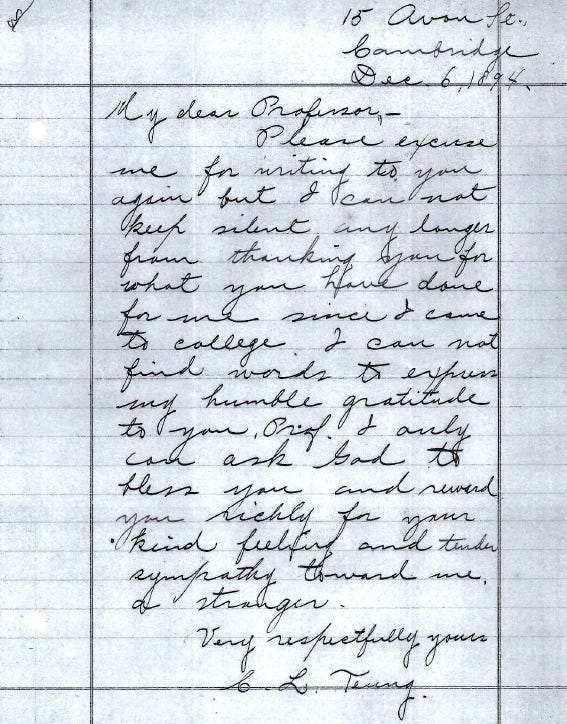
My dear Professor,
Please excuse me for writing to you again, but I cannot keep silent any longer from thanking you for what you have done for me since I came to college. I cannot find words to express my gratitude to you, Prof. I only can ask God to bless you and reward you richly for your kindness and tender sympathy toward me, a stranger.
Very respectfully yours,
C.L. Teung
— Chapter 10 - Breaking the Cycle
Twenty minutes passed before we decided to figure out what was going on.
My parents had told us to wait. So we sat in a sprinter van parked outside a generic building plopped alongside a two-lane road, fields in every direction.
We had already made two stops that day. The first to pay tribute at my father’s parents’ grave site. The second to visit his childhood house in Luo Village, which a “cousin” of his still maintained. The cousin had also walked us to a small patch of grass next to a parking lot, where he claimed my father’s grandfather was buried. There were no markings. We stuck incense sticks in the ground anyway.
Then lunch with a handful more of these “cousins” at a restaurant where every table was round and built for large parties, a spinning wheel in the middle. Smoking indoors was allowed.
But now we were two hours outside Guangzhou, and it felt like my parents had been asking for directions for too long.
I WeChatted my mom. No reply. So we all went inside, not really knowing what to expect.
There were my parents, sitting around a coffee table with two men we had never seen before, drinking tea, chatting and laughing, barely noticing our arrival.
One of the men motioned us over. “Zuo, zuo,” he said. Sit, sit. He stood to make room and pulled over another chair. My mother gathered the kids close to her, and my wife and I crammed in next to this man, who was already pulling out his phone.
“Kan, kan,” he offered. Look, look. He scrolled through his photos, hunting for the right one, then handed me the phone.
A picture of him, holding flowers at a tombstone in Hong Kong. I recognized it. My parents had taken us there a year earlier. It was my great-grandfather’s grave.
He took the phone back, swiped some more, and handed it over again.
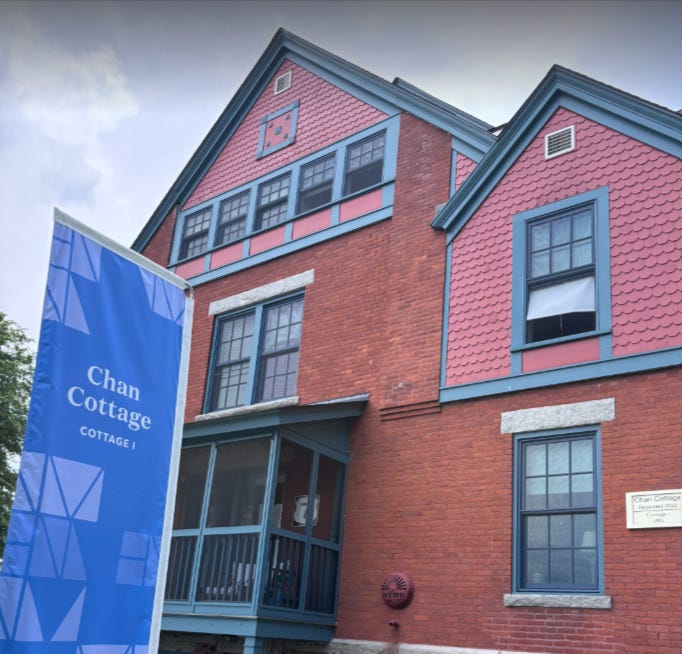
This time he was standing in front of a brick building. The sign behind him read “Chan Cottage.”
Chan is a common Chinese surname. It is also my middle name, and my mother’s maiden name. This stranger, in a building two hours outside Guangzhou, was showing me a picture of himself in Massachusetts, at the prep school my great-grandfather attended in the 1890s, in front of a dormitory named in his honor.
He flipped once more. The same man, standing in Harvard Yard, where my great-grandfather, Loon Teung Chan, had become the university’s first Chinese graduate.
Before I could ask anything, my children were getting restless and my mother urged us along. The men rose, I assumed to say goodbye. Instead they followed us outside and climbed into a beat-up white car that must have been from the 1990s.
They were coming with us.
“That,” my mother explained as our van pulled out behind them, “is the leader of this area.”
“Like a mayor?”
“Something like that. He’s very proud that your great-grandfather came from this tiny village.”
Before she could explain further, our driver came to a stop. We were parked outside a three-story clock tower that sat between a small reservoir and what looked to be a town, nothing more than a grid of one-story buildings and alleyways.
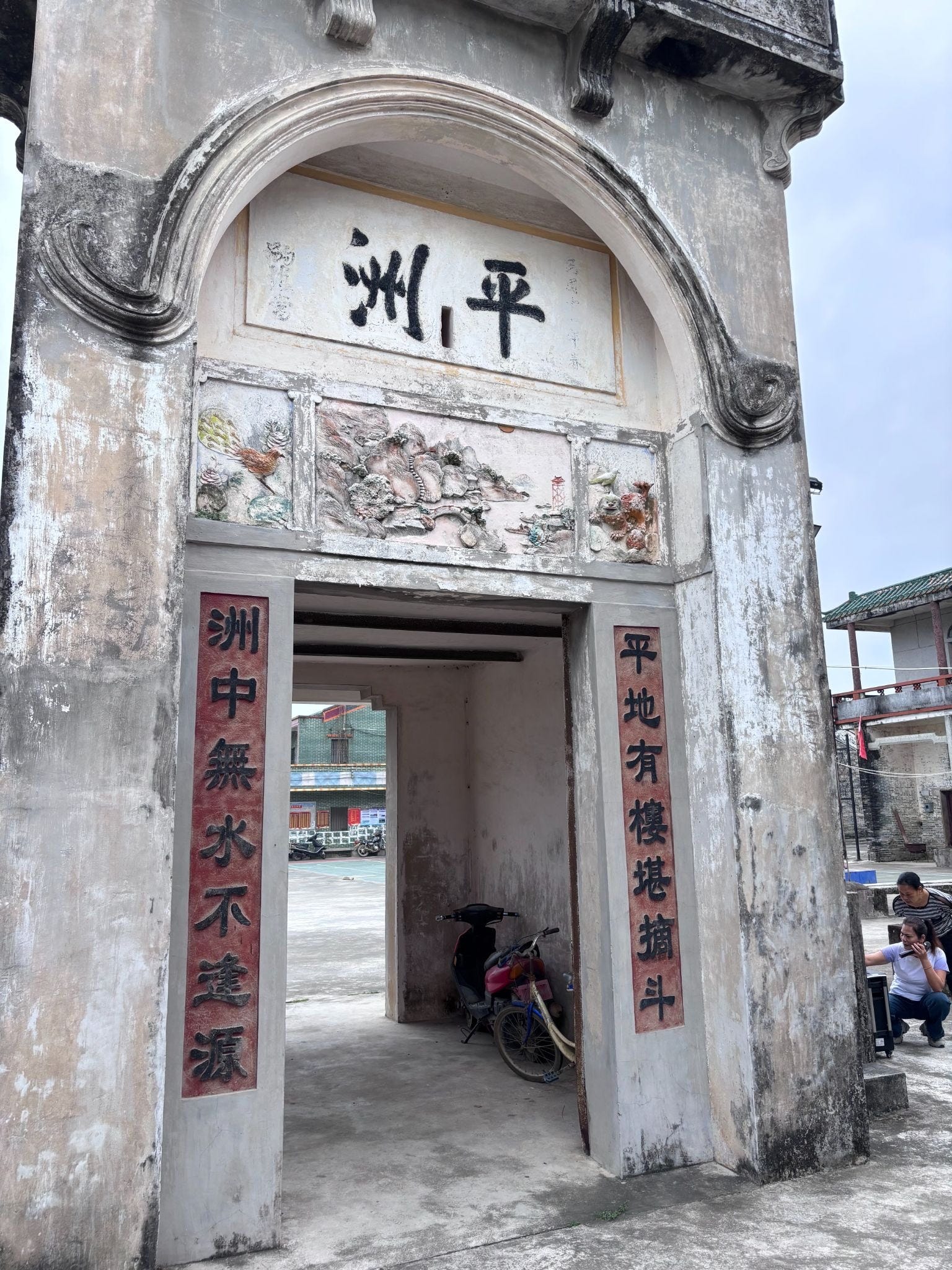
There was nobody around aside from two middle-aged women sitting by the clock tower with a karaoke machine. One singing, the other clapping along. The mayor gestured us through one of the alleys, narrow enough that we had to walk single file.
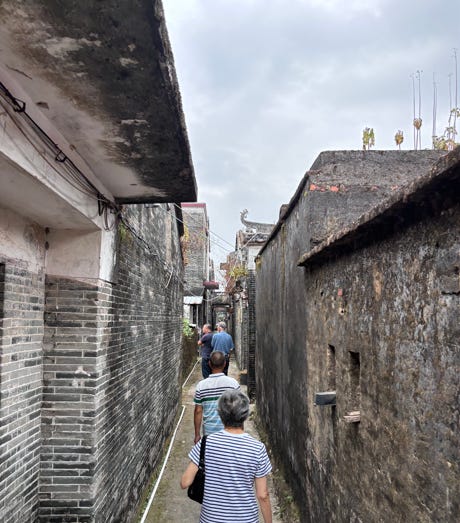
My father turned to the children. “This is the town where your great-great-grandfather grew up!”
Half a block in, the mayor stopped and pointed. There was no building. Just a fence and a handful of chickens scampering around a twenty-by-twenty foot space.
“This is it,” my father said.
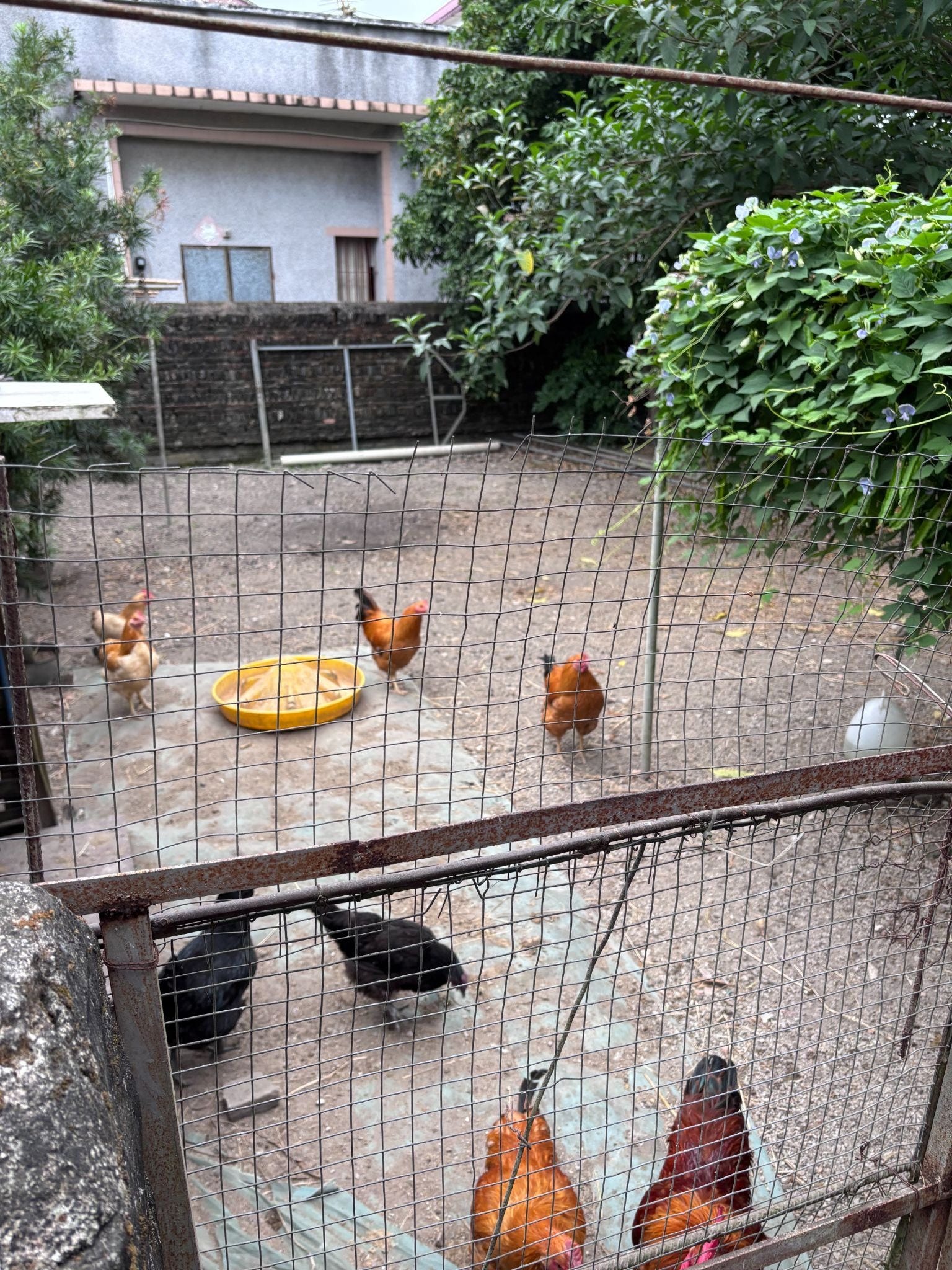
The house where Loon Teung Chan grew up is now a patch of dirt where somebody keeps chickens.
A couple of years into the pandemic, my mother had sent me an article. A dorm at Northfield Mount Hermon, a preparatory school in Massachusetts, had been named in Loon Teung Chan’s honor. The administrators, she said, would be happy to host us anytime.
The summer after our Guangzhou trip, I took an extended leave and we drove cross-country from San Francisco to Boston. My parents flew in to meet us, and we drove together to Northfield Mount Hermon.
The administrators had emailed us which building to meet at, but as we turned onto school property, we realized finding it would be a challenge. The campus felt as though each building sat on its own rolling hill, with a cathedral atop the highest one.
We found what looked to be an administrative building and parked. My mother called the number provided, and we were told to stay put. Before long, two women arrived in a golf cart and introduced themselves.
“Let’s go grab lunch,” said Trish, their Chief Advancement Officer. “Why don’t I take your parents and kids in the golf cart, and you two walk with Marin.”
Though it was summer, the cafeteria, Hogwarts-esque minus the Gothic gloom, was filled with students, many of them international. My kids were mostly delighted by the frozen yogurt machine.
Over lunch we learned about the school. Its history, its founder’s philosophy, its focus on diversity and inclusivity going back more than a century. Loon Teung Chan had arrived after the Chinese Exclusion Act had already been passed into law. The country had formally decided people like him were not welcome. The school admitted him anyway. There, too, he became their first Chinese graduate.
Not a controversial position today, but I cannot imagine the courage it took 130 years ago.
The kids got a bag full of Northfield Mount Hermon swag, including two stuffed pigs, the school mascot, that they still dote on today. They were encouraged to apply once they reach high school age, to which they bashfully nodded.
We toured the campus, and I tried to imagine my great-grandfather here. When we finally reached the cathedral, the cornerstone of campus where graduations are held every year, I started to picture him sitting in its pews. Then I saw the construction date. It was built after he had already graduated. His story predates the campus itself, like an immigrant living in New York before the Statue of Liberty existed.
“We’re so glad you contacted us,” Trish said as we exchanged goodbyes. “We’d be happy to put you in touch with our school historian to capture more about Loon Teung Chan.”
As we drove off, something clicked.
“Wait. They didn’t contact you when they named the dorm?”
“No,” my mother said. “We didn’t find out until later, when I sent you that article. Then I reached out to them. They didn’t know we existed.”
“So how did you find out?”
“Your yi ma.” One of my mother’s sisters. “She saw an article. Remember the man who took us to the village? He wrote an article in China about your great-grandfather, and she happened to read it and forwarded it to me.”
I have spent years excavating my parents’ memories. Writing them down because I believe our family’s story is worth keeping.
And here was a stranger who believed the same thing about somebody else’s family. A man who tracked every piece of news about a person who died long before he was born. Who took a selfie at his gravesite in Hong Kong. Who knew that somewhere in Guangdong, chickens scratch around the dirt where my great-grandfather’s house once stood — while somewhere in Massachusetts, teenagers sleep in a building with his name above the door.
Who wrote an article for a local paper in China that my aunt happened to read. And because of it, three generations of our family spent an afternoon walking the grounds where our ancestor made history. My parents, who left China with nothing. My children, who got stuffed pigs from the bookstore and a nudge to apply when old enough. And my wife and I, somewhere in between.
A moment that wouldn’t have existed otherwise.
Thank you for reading. If you enjoyed, you can find past posts that reveal a bit more about our journey crafting this memoir here:
The Story Behind the Story: on memory, inheritance, and becoming the keeper of a life
The Toad that Ate Swan Meat: on family artifacts, improbable inheritance, and proof
The Book I Couldn’t Read: on language, shame, and finally reading my father
One Hundred Pages: on punishment, preparation, and finding the work waiting for me
Impossible Choices: on family, protection, and the cost of survival
The Art of the Cut: on West Coast Swing, learning when to break the rules and deleting my father’s ex-girlfriends
The Island That Wasn’t There: on carry-on luggage, photobooks, and stories that outlast evidence
Could You Survive on That Island: on cruises, 40 years of tragedy and the parenting paradox
Two Different Races: on reality TV, Confucianism and naming the unnamed
Blessed: on broken bones, death threats and irrational belief
Don’t Be Scared: on keeping secrets, basketball and the chapter that came to be
Connections, connections, connections.
We're all in a spiderweb that we can barely see even with all the social media that we're in now.
I remember when Facebook opened up to our campus as one of the first universities while in graduate school. Remember when you could actually see the connections you made and drag the 3D map around to see it?
I could tell you stories about random encounters that I've had with our dance team members in the real world after college that were completely unplanned, but happened because of a million small moments and actions that came together to make them happen.
Anyway, beautiful story, man. Just goes to remind us that we're not alone, that we're not the only ones who care about the threads we weave or that our families did. There's a sort of karmic balance in what you're doing and how it's playing out. Thanks for sharing your journey!
Henry, that is the craziest story… China to Northfield and connected through random articles and basic research and luck. Amazing.